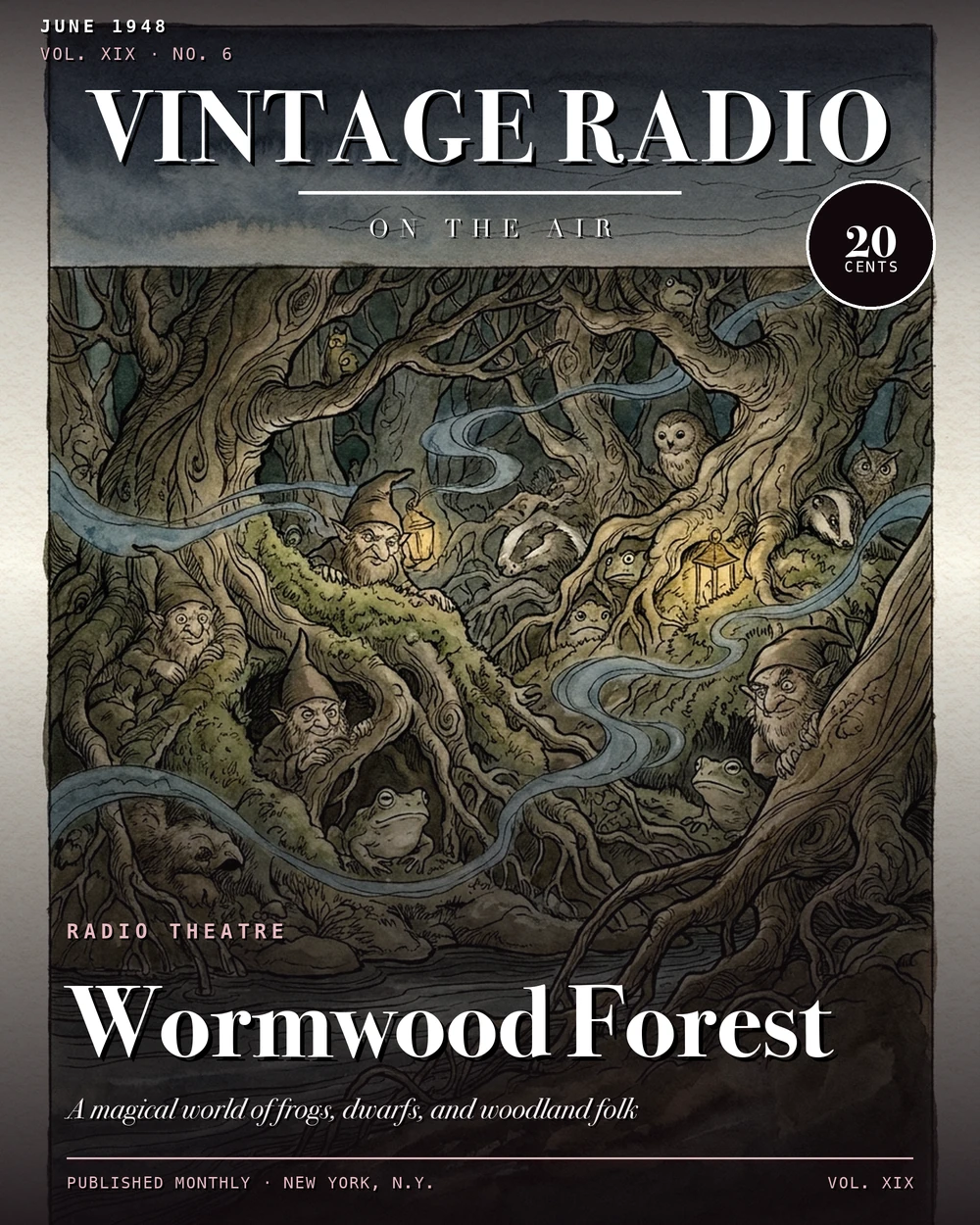
Wormwood Forest
A Nashville Puppeteer Builds a World on the Radio
Wormwood Forest started not with a network deal or a sponsor's pitch meeting, but with a puppeteer doing shows at Nashville libraries. Tom Tichenor had been performing for children since 1938, working local events and building an audience one story at a time. By 1947 he had brought his woodland characters to WSM, the powerful Nashville station broadcasting at 50,000 watts. The show found its feet there as a local program before NBC picked it up for a national run that began on January 8, 1949. For sixteen weeks — through April 30, 1949 — Tichenor broadcast live from WSM to audiences across the country.
The concept was simple and specific: a hotel called the Dwarf Waldorf, nestled somewhere in a place called Wormwood Forest, populated by an improbable collection of talking animals and at least one dwarf. Tichenor wrote every episode himself and voiced several characters, including Dippy Dwarf, the hotel proprietor at the center of most stories. This was a one-man creative operation, supported by collaborators but driven entirely by his imagination.
The Characters Who Lived in the Forest
The guest registry at the Dwarf Waldorf would strain any actual hotel. Frankie Frog worked as the hotel assistant, and Tallulah Tobacco Worm served as secretary. Then there was Georgeous Frog — with that distinctive spelling — along with Big Boy Bear the Bone Crusher, Barbara Q Pig, Suzie Skunk, and the Valentine-seeking Dippy Dwarf himself. Beyond the regulars, the full ensemble extended to Dumbcluck the Woodchuck, Eager Beaver, Gerald Grasshopper, Grandpa Fox, Henrietta Hen, Muscles Muskrat, Oleander Salamander, Postman Possum, Sherlock Hound, Siamese Pretty Kitty, Strauss Mouse, Swami Salami, Swindler Q. Fox, and Timothy Turtle.
That list suggests something about the show's sensibility — crowded, inventive, and uninterested in playing it safe with a small ensemble. The names alone — Swami Salami, Swindler Q. Fox — have a vaudeville energy to them, a delight in the comic sound of words. Tichenor's background was in physical performance with puppets, and that instinct for exaggerated, character-driven comedy seems to have transferred directly to the audio format.
What Actually Happened in Wormwood Forest
The episode titles give a good sense of the show's tonal range. Some episodes leaned into the mildly absurd domestic: "Barbara Q Pig Wants to Build a Hotel," "Barbara Q Pig Changes Hotel Plans," and "Barbara Q Pig Has Noise Problems" form a loose arc that sounds more like a planning dispute at a neighborhood association than a children's fairy tale. Others went in a physical comedy direction — wrestling turns up repeatedly, with episodes like "Wrestling Match in the Brook," "Frankie Frog to Become a Wrestler," and "Georgeous Frog vs Big Boy Bear the Bone Crusher" suggesting that the Dwarf Waldorf had a sporting culture all its own.
The holiday episodes leaned on familiar children's-programming conventions: "Dippy Dwarf Needs a Valentine" and "Georgeous Frog vs The Easter Bunny" fit the seasonal calendar in the way any self-respecting kids' show had to. And then there was "Suzie Skunk's Radio Problems," which presumably found comedy in the meta-territory of a radio character having trouble with radio — a small, clever choice.
The Disney Episode
The most unusual broadcast in the sixteen-episode NBC run was "Dippy Dwarf's Letter from Disney," which aired on January 22, 1949. In it, Walt Disney appeared as himself and also as Mickey Mouse, while Clarence Nash — the man behind Donald Duck's voice — appeared as Donald Duck. On a children's radio show built around a Nashville puppeteer's woodland hotel, that was a remarkable guest list.
Tichenor had written the episode around the conceit of Dippy Dwarf receiving correspondence from the Disney company, connecting the small, local world of Wormwood Forest to the most recognizable name in American children's entertainment at the time. That Nash appeared as Donald Duck is particularly notable; his vocal performance as the duck was among the most recognized character voices on American radio or film. The episode gives some sense of the ambition Tichenor and WSM had for the show during its national run.
Recognition and What Came After
WSM's investment in the program paid off in at least one measurable way: the show received two awards from Billboard Magazine for locally-produced children's radio on a 50,000-watt station. For a program written and performed largely by one man out of a Nashville studio, that kind of trade recognition mattered.
When the NBC run ended in April 1949, Wormwood Forest didn't simply vanish. It continued on WSM and other stations through at least June 1951, running for roughly two more years after the national network dropped it. The show also became the basis for a television version starting in 1950, as Tichenor adapted the same characters and world for the new medium — a natural move for a performer whose primary craft was visual puppetry.
Tichenor's career after Wormwood Forest remained rooted in children's performance but eventually reached national visibility through a different avenue. He became WSM's first local Bozo the Clown in 1959, then left that same year to pursue a Broadway opportunity. That opportunity was the musical Carnival!, which opened in 1961. Tichenor designed and built the original puppets for the show, and those puppets appeared on the cover of Life magazine on May 5, 1961. He had started doing puppet shows at libraries in 1938 and maintained a lifelong connection to the Nashville Public Library; by the time Carnival! opened, he had been at it for more than two decades.
Tom Tichenor was born February 10, 1923, and died November 18, 1992. The sixteen NBC episodes of Wormwood Forest — the frogs in wrestling matches, the pig with hotel ambitions, the dwarf with a letter from Disney — represent a brief national moment in a career that was otherwise mostly local and mostly live.